
Decoding Your Love Map: A Guide to Attachment Styles in Dating
Have you ever wondered why you’re a "text-back-immediately" person while your partner seems to disappear for hours? Or why some people run for the hills the moment things get serious?
If you’ve found yourself Googling "avoidant partner behavior" at 2:00 AM or wondering why "anxious attachment in dating" feels like your personal biography, you aren't alone. Attachment theory has exploded in popularity because it provides the ultimate "cheat code" for understanding why we love the way we do.
What Exactly is Attachment Theory?
Developed by psychologist John Bowlby and expanded by Mary Ainsworth, attachment theory suggests that our earliest bonds with caregivers create a blueprint for how we perceive intimacy and safety in adulthood.
Understanding these patterns isn't about labeling yourself or your partner—it's about predictability. When you know the "why" behind the behavior, you can stop reacting and start relating.
The Four Main Attachment Styles
Most people fall into one of these four categories. Which one resonates with you?
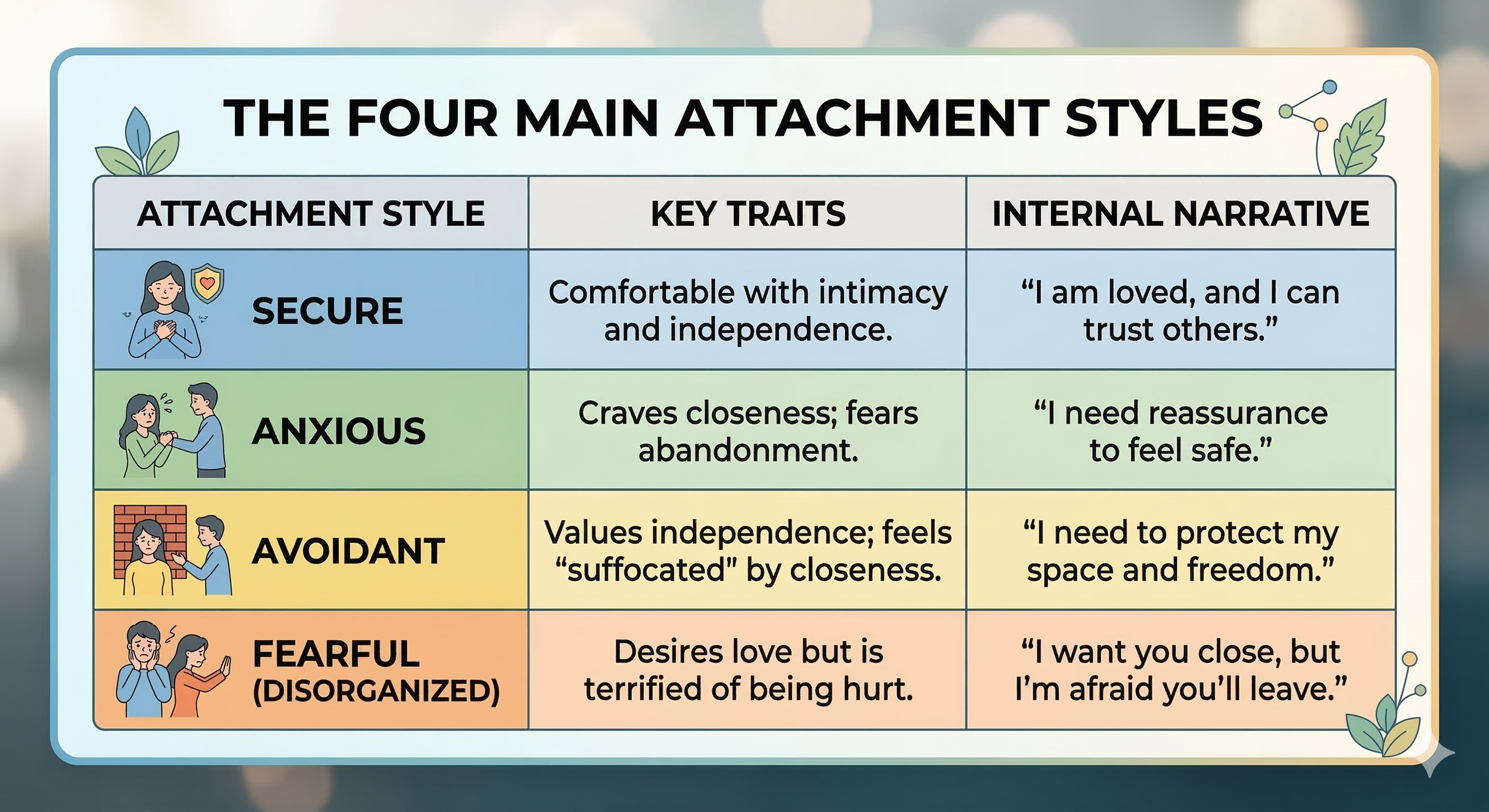
Why Attachment Styles Are "Make or Break" in Dating
Your attachment style acts as a filter for every interaction you have. It specifically influences three major pillars of a relationship:
Communication of Needs: A secure person asks for what they need directly. An anxious person might use "protest behavior" (like acting out), while an avoidant person may not mention their needs at all.
Conflict Resolution: In a heated moment, avoidant partners often withdraw to "self-regulate," which can inadvertently trigger an anxious partner to pursue them even harder for reassurance.
Intimacy Thresholds: Everyone has a "comfort zone" for closeness. When that zone is breached, those without secure patterns may use distancing tactics to regain a sense of control.
The "Anxious-Avoidant Trap": This is a common dating cycle where an anxious person is drawn to an avoidant person. The anxious partner pursues, the avoidant partner retreats, and the cycle repeats—often creating a high-intensity (but exhausting) chemistry.
The Good News: You Aren't Stuck
The most empowering thing about attachment theory is that styles are not a life sentence. Through a process called Earned Security, you can move from an insecure style toward a secure one. This happens through:
Self-Awareness: Noticing your triggers in real-time.
Choosing Secure Partners: Dating people who are consistent and reliable.
Therapy: Working through the "blueprint" of your past to build a better future.
Understanding your attachment style is the first step toward a relationship that feels like a safe harbor rather than a stormy sea.
🧭 Mini-Quiz: What’s Your Primary Dating Style?
Read the following scenarios and note which "Reaction" sounds most like you. Don't overthink it—go with your gut!
Scenario 1: Your partner hasn’t texted you back in 6 hours.
A) I assume they’re busy and will get back to me when they can. I keep going with my day.
B) I feel a pit in my stomach. I check their "last seen" status and wonder if I said something wrong.
C) I barely notice. Honestly, I appreciate the space and hate feeling like I have to check in constantly.
Scenario 2: Things are getting serious and you’re discussing "The Future."
A) I feel excited! It feels natural to plan a life with someone I care about.
B) I feel relieved that they’re finally committing, but I still worry they might change their mind.
C) I feel a bit trapped or pressured. I start thinking about all the things I’ll have to give up.
Scenario 3: You’ve just had a heated argument.
A) I want to talk it out calmly so we can find a resolution and move on.
B) I need to fix it right now. I can’t relax or sleep until I know we are "okay."
C) I need to get away. I usually shut down, leave the room, or need a few days of silence to cool off.
The Results:
Mostly As: The Secure Base. You view relationships as a source of support. You aren't afraid of intimacy, but you don't lose yourself in it either.
Mostly Bs: The Anxious Heart. You are deeply attuned to your partner’s shifts in mood. Your "alarm system" is highly sensitive, and you thrive on consistent reassurance.
Mostly Cs: The Independent Avoidant. You equate "closeness" with "loss of freedom." You tend to keep your guard up to protect your autonomy, even when you really like someone.
Note: Many people are a "mix." For example, you might be Secure with one partner but find yourself acting Anxious with someone who is Avoidant!
